Comparing Luxury Homes in Littleton MA: Nagog Pond Versus Town Center
What should you look for when comparing two luxury homes in Littleton, MA, priced similarly but in different parts of town, like near Nagog Pond versus closer to the town center?
You should compare assessed values, annual tax bills, infrastructure differences (well and septic versus municipal water and sewer), lifestyle trade-offs between waterfront privacy and commuter convenience, and long-term resale liquidity before choosing between these two distinct Littleton micro-markets.
Why This Matters Right Now in Littleton, MA
If you are weighing two luxury homes at a similar price point in Littleton, MA, the sticker price alone tells you very little. What many buyers do not realize is that two homes carrying the same list price can have meaningfully different carrying costs, due-diligence requirements, and resale profiles depending on whether they sit near Nagog Pond or closer to the town center.
We have seen this play out many times while helping buyers and sellers throughout Littleton and the surrounding communities. The decision between these two parts of town is really a lifestyle decision wrapped in a financial one. With 28 years in the business and over 550 closed transactions, we can tell you that the buyers who take time to compare beyond surface-level features are the ones who feel most confident years after closing. So what exactly should you be looking at? Let us walk through it.

How Property Taxes Differ on Similarly Priced Littleton Homes
Here is something that catches many luxury buyers off guard: two homes listed at the same price in Littleton can produce different annual tax bills. Why? Because Littleton applies a single residential property tax rate of $14.02 per $1,000 of assessed value for FY2026, according to Massachusetts law about property taxes. The rate is uniform across town, but the assessed value of each property is not.
Why Assessed Value Varies by Neighborhood
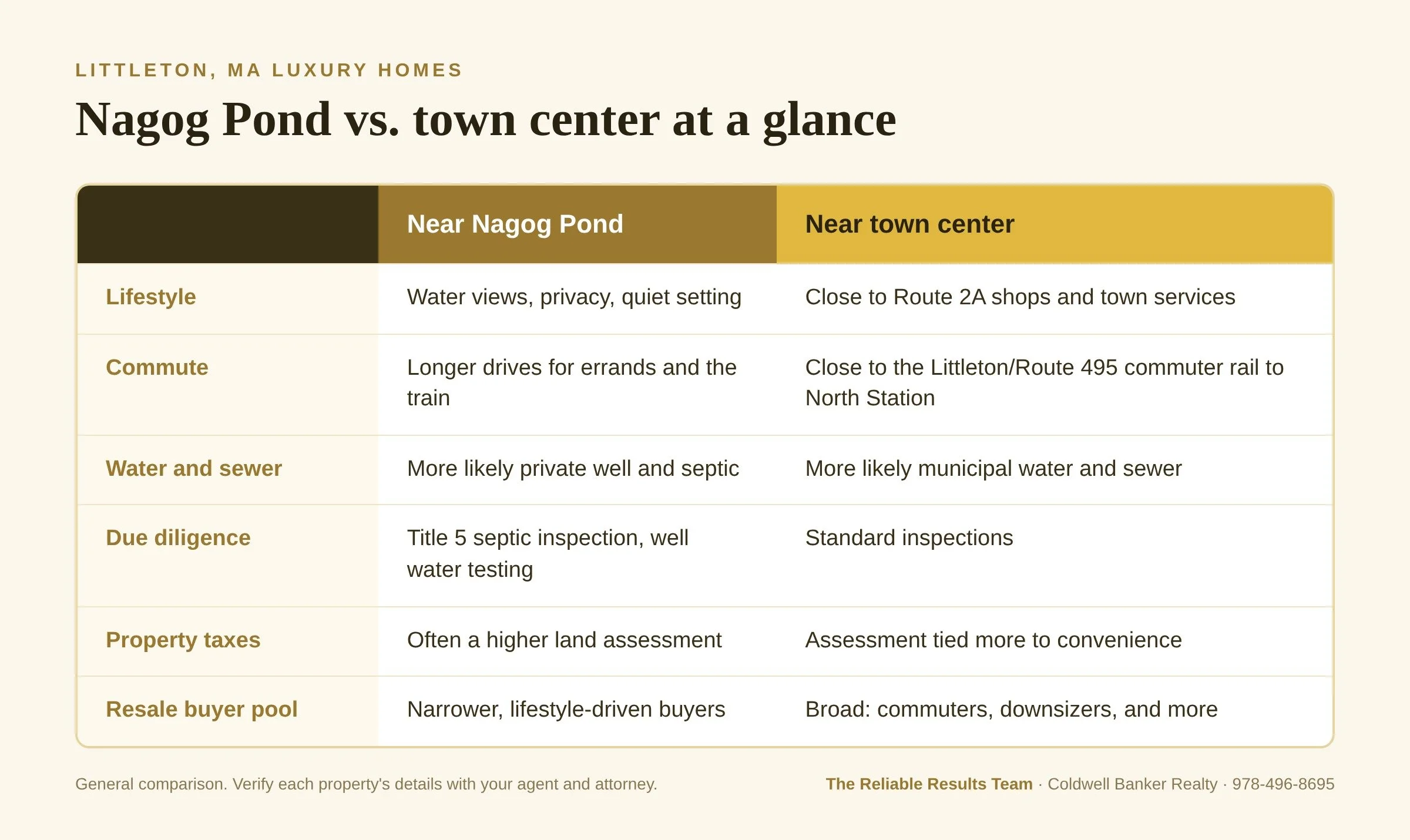
The town assessor determines each parcel's assessed value by looking at both the land component and the building component. Properties near Nagog Pond typically carry a higher land-value assessment because of water adjacency, scenic views, and privacy. A town-center home at the same purchase price may have a lower land assessment because the premium there is tied to convenience rather than natural amenity.
What does that actually mean for your wallet? Consider a simplified comparison using the FY2026 rate of $14.02 per $1,000 of assessed value:
Home A (assessed at $1,200,000): Approximately $16,824 per year in property taxes
Home B (assessed at $1,050,000): Approximately $14,721 per year in property taxes
That is roughly a $2,100 annual difference on homes that may have been listed at similar prices. Over a decade, that gap adds up. Before you make an offer on either property, request the current assessed value breakdown, separating land from building, so you can project your true carrying costs.
Under Massachusetts's Proposition 2½, the total property tax levy in any community generally cannot exceed 2.5% of the full and fair cash value of all taxable property, and annual levy increases are capped. However, individual assessed values, especially on waterfront land, can rise faster than the town average. So while the system provides structural stability, it does not freeze your personal tax bill. We always encourage buyers to consult a tax professional for specifics on how Proposition 2½ may apply to their situation.
Lifestyle Trade-Offs: Nagog Pond Privacy vs. Littleton Town Center Convenience
This is the question we find ourselves discussing most often with luxury buyers in Littleton. It is not really about which home has better finishes. At this price point, both homes are probably beautifully appointed. The real question is how you want to live day to day.
What Nagog Pond Offers
Nagog Pond sits in the western part of Littleton, and properties along its shores are among the most private and scenic in town. If your ideal morning starts with water views, quiet surroundings, and separation from neighbors, this part of Littleton delivers. You may also find larger lot sizes, mature tree coverage, and the possibility of deeded pond access, depending on the specific parcel.
But that privacy comes with practical considerations. Daily errands, dining, and commuting may require longer drives. You should factor in the time and cost of those routines before falling in love with a view.
What Town Center Proximity Offers
Closer to the center of Littleton, you gain walkability to Route 2A retail, town services, and, importantly, the Littleton/Route 495 MBTA Commuter Rail station on the Fitchburg Line, which provides direct rail access to Boston's North Station. For buyers who commute, that proximity can save meaningful time every week.
Town-center homes also tend to appeal to a broader range of future buyers, including commuters, downsizers, and families, which can matter when you think about resale. In our experience, understanding what buyers are looking for in each part of town is essential to making a smart purchase and positioning yourself well for the future.
Infrastructure and Due Diligence Differences in Littleton, MA
This is where the comparison between Nagog Pond and town center gets into territory that many luxury buyers do not anticipate. The homes may look comparable on paper, but the infrastructure underneath them can be very different.
Well and Septic vs. Municipal Services
Luxury homes near Nagog Pond are more likely to rely on private well water and septic systems. Town-center properties are more likely to connect to municipal water and sewer. That distinction has real implications:
Septic inspection (Title 5): Massachusetts generally requires a Title 5 septic system inspection in connection with a property transfer. You should budget for this inspection and understand what a pass, conditional pass, or fail means for your timeline and negotiating position. Consult your attorney for the specific requirements that apply.
Water quality testing: A private well means you are responsible for your own water supply. A comprehensive water quality test should be part of your due diligence on any pond-area property.
Ongoing maintenance: Septic systems require periodic pumping and eventual replacement. Municipal sewer does not. This is a carrying cost that does not show up in the listing price.
We know that buying a home is about more than square footage and listing prices, and infrastructure is a perfect example. These systems affect both your budget and your peace of mind. With 200 five-star client reviews, we have built our reputation on helping buyers work through exactly these kinds of details.
Flood Zone and Wetlands Considerations Near Nagog Pond
Pond-adjacent parcels in Littleton may fall within FEMA flood zones or be subject to Massachusetts Wetlands Protection Act buffer zones. These designations can restrict your ability to add outbuildings, expand the footprint, or even alter landscaping.
The good news is that MassGIS maintains standardized assessors' parcel mapping data for Littleton, with the current parcel dataset created on July 2, 2026. Your buyer's agent can use this data layer to verify wetland buffers, lot boundaries, and flood zone overlays before you make an offer. We recommend checking this early in the process rather than discovering restrictions after you have already fallen in love with a property.
Resale Liquidity: Which Part of Littleton Holds Value More Broadly?
When you are investing at the luxury level in a town like Littleton, MA, resale liquidity matters. Life circumstances change, and you want confidence that your home will attract qualified buyers if you decide to sell.
Town Center Draws a Wider Buyer Pool
Homes near the town center appeal to a diverse range of buyers: commuters who value the MBTA rail station, families drawn to the convenience of town services, and downsizers who want to simplify without leaving the community. That breadth of demand generally supports a more liquid resale market.
Nagog Pond Appeals to a Niche Audience
Pond-adjacent properties attract a lifestyle-driven buyer, someone specifically seeking waterfront privacy, natural beauty, and seclusion. That buyer exists, but the pool is narrower. A home that is harder to sell quickly represents a risk factor, even when it is the more beautiful property.
Does that mean you should avoid Nagog Pond? Not at all. It means you should go in with clear expectations about your time horizon and a thoughtful pricing strategy if and when you sell. As recognized Top 4% agents among all agents worldwide within our brokerage and Platinum Producers with the Northeast Association of Realtors, we bring the kind of strategic marketing perspective that accounts for these differences.
Littleton's total taxable estate valuation stands at approximately $3.6 billion for FY2026, per the town's annual return filed with the Commonwealth, reflecting a growing and well-valued residential base. That is encouraging for long-term homeowners in both parts of town.
Building Your Comparison Framework for Littleton Luxury Homes
Rather than choosing based on a feeling during a showing, we recommend building a structured side-by-side comparison. Here are the key categories:
Assessed value and projected annual tax bill (request the land vs. building breakdown)
Infrastructure type (well/septic vs. municipal water/sewer)
Flood zone and wetlands status (verify via MassGIS parcel data)
Commute time and daily routine impact (proximity to the Littleton/Route 495 MBTA station and Route 2A)
Lot size and restrictions on future improvements
Resale buyer pool size and historical demand in that micro-market
Privacy and lifestyle alignment (waterfront serenity vs. village walkability)
In Littleton, factors like location, property condition, updates, outdoor space, and proximity to everyday conveniences all influence a home's appeal and value. We believe every property deserves a thoughtful strategy, and understanding cash to close in real estate transactions is also part of that framework.

Frequently Asked Questions
Does the property tax rate differ between Nagog Pond and Littleton town center?
No. Littleton applies a single residential property tax rate of $14.02 per $1,000 of assessed value for FY2026, according to the town's annual return filed with the Commonwealth. The rate is uniform across all residential parcels. However, the assessed value of your specific property will vary based on land value, water adjacency, and other factors, so your actual tax bill can differ even at the same purchase price.
What is a Title 5 inspection, and do I need one near Nagog Pond?
A Title 5 inspection evaluates the condition of a septic system. Massachusetts generally requires one in connection with a property transfer, though specific requirements and timelines can vary. Homes near Nagog Pond that rely on septic systems will likely need this inspection. It is a standard part of due diligence, and the results can influence your offer negotiation. Your real estate attorney can confirm the requirements for your situation.
How does proximity to the MBTA commuter rail affect home value in Littleton?
The Littleton/Route 495 MBTA Commuter Rail station on the Fitchburg Line provides direct access to Boston's North Station. Town-center homes benefit from shorter commute times to the station, which tends to broaden the buyer pool and can support stronger demand over time. If you commute regularly, this proximity can meaningfully improve your quality of life.
Are there building restrictions on properties near Nagog Pond in Littleton?
Pond-adjacent parcels may fall within FEMA flood zones or be subject to Massachusetts Wetlands Protection Act buffer zones. These overlays can restrict additions, outbuildings, and landscaping. You should verify the specific restrictions on any parcel using MassGIS data, which was updated for Littleton as of July 2, 2026, or consult with the town's conservation commission.
Should I worry about water quality with a private well near Nagog Pond?
Private well water quality should always be tested as part of your due diligence. Unlike municipal water, which is tested and treated by the town, well water quality is your responsibility. A comprehensive test can identify potential issues before you close, giving you leverage to negotiate repairs or treatment systems if needed.
Which part of Littleton has better resale value for luxury homes?
Neither location is inherently "better" for resale value. Town-center luxury homes tend to attract a broader buyer pool, which can support faster sales. Nagog Pond properties attract a more niche, lifestyle-driven buyer. Your resale outcome depends on your pricing strategy, the condition of the home, and how well the listing is marketed to the right audience.
How do I find out if a Littleton property is in a flood zone?
MassGIS maintains standardized parcel mapping data, with files for Littleton created as recently as July 2, 2026. Your buyer's agent or attorney can cross-reference the parcel with FEMA flood zone maps. We recommend checking this before making an offer, not after.
What is Proposition 2½, and how does it affect my taxes in Littleton?
Proposition 2½ is a Massachusetts law that generally caps the total property tax levy in a community at 2.5% of the full and fair cash value of all taxable property. Annual levy increases are also limited. It provides structural tax stability, but it does not freeze individual tax bills. Your assessed value can still rise, especially on waterfront land. Consult a tax professional for details on how this applies to your specific situation.
Is Nagog Pond in Littleton a public or private pond?
Nagog Pond is a natural pond in the western part of Littleton. Access rights and usage may vary by property. Some homes may have deeded pond access, while others may not. You should verify the specific access rights tied to any parcel you are considering, ideally through your attorney's review of the deed and any associated easements.
How do I choose between two similarly priced luxury homes in different parts of Littleton?
Build a structured comparison that goes beyond aesthetics. Compare assessed values and projected tax bills, infrastructure types, flood zone and wetlands status, commute times, resale buyer pool size, and lifestyle alignment. What we tell our clients is that the home that fits your daily routine and long-term goals is always the right choice, even if the other home has a more dramatic first impression.
The Bottom Line
Comparing two luxury homes in Littleton, MA, that are priced similarly but sit in different parts of town is not as simple as picking the one with the better kitchen. Nagog Pond offers privacy, natural beauty, and a retreat-like setting, but it comes with infrastructure considerations and a narrower resale audience. The town center delivers commuter rail access, walkability, and broader buyer appeal, but with a different daily lifestyle.
For us, real estate has always been about more than transactions. It is about building relationships, sharing local knowledge, and helping people feel confident about one of their biggest decisions. With 28 years of experience and over 550 closed transactions, we are here to help you evaluate the details that matter, from how much it costs to sell a home in Westford, MA in 2026 to septic inspections to resale strategy.
When you are ready to compare properties in Littleton, MA, with the support of a team that knows this town inside and out, reach out to us at the Reliable Results Team at 978-496-8695. We would love to help you make your next move with confidence.