9 Things We'd Check Before Buying a Home in Littleton, MA
What should you check before buying a home in Littleton, MA?
Before buying in Littleton, you should verify property taxes, septic and Title 5 compliance, water source, wetlands restrictions, inspection scope for older homes, deed restrictions, tax implications, lot boundaries, and utility infrastructure.
Why This Matters Right Now in Littleton
Littleton has long attracted buyers who want the combination of larger lots, small-town character, and easy access to the Route 2 and I-495 corridors. But those same qualities that make the town so appealing can also introduce layers of due diligence that buyers from more suburban or urban settings might not anticipate.
We've seen firsthand what makes Littleton such an appealing place to call home, from its beautiful residential neighborhoods to its strong sense of community. With 28 years in real estate and over 550 closed transactions, we know that buying here is about more than square footage and listing prices. It is about understanding the local nuances, knowing what to look for, and making decisions that support your long-term goals.
So what exactly do we look at when helping a buyer evaluate a property in Littleton? Here are the nine things we check every time.
1. Property Taxes and the Real Cost of Ownership in Littleton
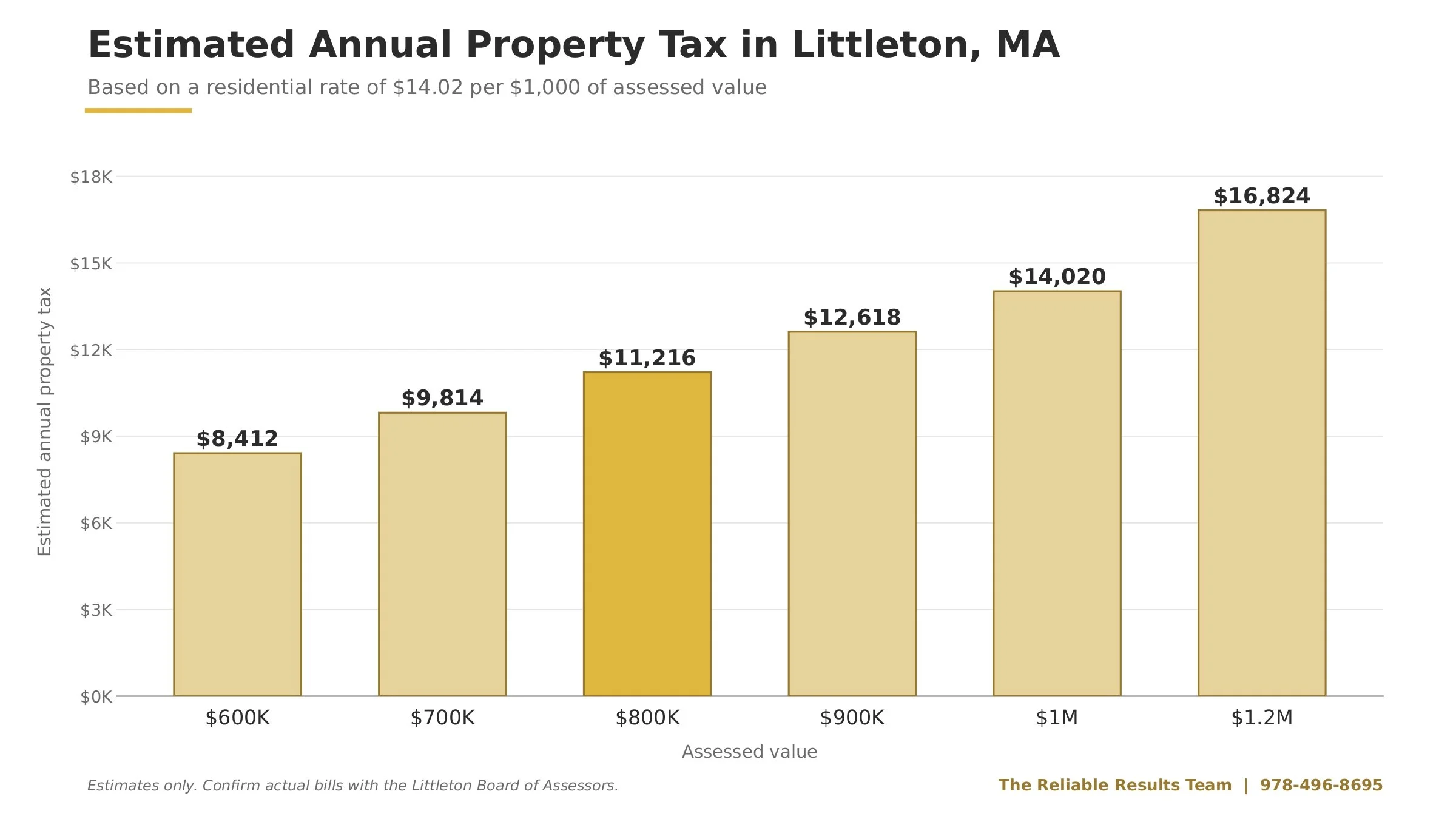
You might fall in love with a home's curb appeal, but the annual tax bill is what you will live with year after year. Littleton's residential property tax rate was $14.02 per $1,000 of assessed value for the year ended December 31, 2025, according to the town's annual report filed with the Commonwealth.
What does that actually mean for your budget? For a home assessed at $800,000, the estimated annual tax bill would be roughly $11,216. Keep in mind that actual bills depend on the assessor's valuation and any applicable exemptions, so you should request the current assessed value directly from the Littleton Board of Assessors.
Here is the part many buyers overlook: Massachusetts Proposition 2½ limits annual property tax levy increases to 2.5% of the prior year's levy limit plus new growth, according to the Massachusetts Division of Local Services for FY2026. That structural cap provides meaningful predictability for your future tax bills. However, you should ask whether Littleton has any active debt exclusions or capital exclusions on an upcoming ballot, because those can temporarily exceed the cap.
We always recommend that our buyers look beyond the listing price and calculate total cost of ownership, including taxes, insurance, and infrastructure costs. In Littleton, that calculation is especially important given the variety of property types and lot sizes.
2. Septic Systems and Title 5 Compliance in Littleton, MA
This is one of the single most consequential items on any Littleton buyer's checklist. Many homes in town, particularly those on larger lots, rely on private septic systems rather than municipal sewer connections.
Massachusetts law requires a Title 5 inspection of private septic systems at the time of sale. If the system fails inspection, the path forward generally involves either repairing or replacing the system before transfer, or the buyer assuming the obligation under an escrow agreement — both are recognized options, and understanding which applies to your situation is an important part of your due diligence. The cost of a full system upgrade can run into the tens of thousands of dollars, so this is not a detail you can afford to overlook.
What We Check on Title 5
Age and design flow capacity relative to the home's bedroom count
The most recent Title 5 inspection report, including any conditions or caveats
Proximity of the leach field to wells, wetlands, or property boundaries
Whether the existing system can support future expansion if you plan to add bedrooms or a guest suite
We tell our clients that a Title 5 report is not just a pass/fail document. It tells a story about the property's infrastructure, and understanding that story before you make an offer can save you significant expense and stress.
3. Water Source and Quality Testing in Littleton
Littleton is served by the Littleton Electric Light and Water Department, a municipally owned utility, according to the town's annual report filed with the Commonwealth. However, some parcels, particularly on larger lots in more rural stretches of town, rely on private wells.
If you are looking at a property on private well water, we strongly recommend ordering an independent water quality test before you remove your inspection contingency. Your test should cover, at minimum:
Bacteria and coliform
Nitrates
Arsenic
PFAS (per- and polyfluoroalkyl substances), which have been identified at elevated levels in parts of Massachusetts
Confirming the water source early in your due diligence prevents surprises at closing. Even if the property connects to the municipal system, you should verify that the connection is current and that there are no outstanding assessments or required upgrades.
Does this level of detail seem like overkill? In our experience, it is the buyers who skip these steps who end up with the most expensive surprises after move-in.
4. Inspection Scope for Older New England Homes in Littleton
A standard home inspection covers the basics, but Littleton's residential stock includes homes built across multiple eras, from antique farmhouses to newer construction. If you are purchasing a higher-value property, a standard inspection may not be enough.
Specialist Inspections We Recommend
Oil tanks: Both above-ground and below-ground tanks can present environmental liability. Underground tanks that have leaked can trigger costly remediation requirements.
Radon testing: Middlesex County sits on granite-rich geology, and radon is a known concern in the region. A radon test is inexpensive and can be addressed with a mitigation system, but you want to know before you close.
Chimney and fireplace inspection: Many Littleton homes feature wood-burning fireplaces or wood stoves. A Level 2 chimney inspection is appropriate when you are purchasing a home.
Roof, HVAC, and major mechanicals: On luxury properties, replacing a roof or heating system can cost tens of thousands of dollars. We want to know the age and condition of every major system before our buyers commit.
In Littleton, property condition, updates, and outdoor space are key value drivers. We have seen situations where a buyer fell in love with a property's charm without fully understanding the deferred maintenance beneath the surface. A thorough inspection protects your investment.

5. Wetlands, Conservation Land, and Deed Restrictions in Littleton, MA
Littleton contains significant conservation land and wetlands regulated under the Massachusetts Wetlands Protection Act. If you are buying near ponds, streams, or low-lying areas, you should obtain a wetlands determination before committing to the purchase.
Why does this matter for you? Wetlands regulations can restrict what you are allowed to build, excavate, or modify within buffer zones. For luxury buyers who plan to add a pool, expand a home, or develop outdoor living space, this is a critical step.
What Else to Check
Deed restrictions: Some properties carry restrictions on use, subdivision, or alteration that may not be immediately obvious from a listing description.
Historic preservation restrictions: These can limit exterior modifications, materials, and design choices.
HOA covenants: Even in a town like Littleton that does not feel "HOA-heavy," some neighborhoods and developments do have covenants that regulate everything from fencing to accessory structures.
We always recommend completing a thorough title search and reviewing the town's GIS parcel data, which MassGIS updated for Littleton in June 2026, before your inspection contingency expires. This is the kind of detail that sets informed buyers apart from those who learn about restrictions after closing.
6. Lot Boundaries, Survey, and Parcel Data in Littleton
On larger Littleton lots, assumptions about where your property ends and your neighbor's begins can lead to disputes, especially when it comes to fences, driveways, outbuildings, or tree removal. We recommend ordering a current property survey for any property where the boundaries are not clearly defined by recent markers or a recorded plan.
With Littleton's total taxable estate valuation reaching $3,601,781,018 as of the year ended December 31, 2025 (per the town's annual report), the scale of the residential base here is substantial.. A survey also helps you verify:
Setback compliance for existing structures
Easements that may cross the property (utility easements, access rights)
Encroachments from neighboring properties
Rated 5 out of 5 stars by 200 past clients, we take pride in helping buyers think through these details before they become problems. A survey is a small investment relative to the cost of a boundary dispute after you have already closed.
7. Massachusetts Tax Implications for High-Value Buyers in Littleton
If you are purchasing a luxury home in Littleton, you likely have a financial advisor and CPA on your team already. But it is worth highlighting a few Massachusetts-specific tax considerations that can affect your long-term financial planning.
Massachusetts personal income tax rate: 5.00% for tax year 2026, per the Massachusetts Department of Revenue
Millionaire's surtax: An additional 4% applies to income exceeding $1,107,750 for tax year 2026, per the Massachusetts Department of Revenue
Short-term capital gains: Massachusetts imposes a separate short-term capital gains rate; confirm the current rate with your CPA, as it may affect your exit strategy
If you plan to hold a property and eventually sell, you should factor these rates into your exit strategy. We recommend involving your real estate attorney and CPA early in the process, not after you have signed a purchase and sale agreement.
Many of the buyers we work with are relocating from higher-density communities and are comparing Littleton's tax structure and land availability favorably against alternatives. Understanding the full tax picture helps you make that comparison with confidence.
8. Utility Infrastructure and Municipal Services in Littleton, MA
Littleton's municipally owned electric and water utility, the Littleton Electric Light and Water Department, is a notable feature of the town.
When evaluating a specific property, check:
Whether the home connects to municipal water or relies on a private well
Heating fuel source: oil, natural gas, propane, or electric
Internet and connectivity options, which can vary by location within town
Road maintenance responsibility: some longer driveways or private roads may be the homeowner's responsibility to maintain and plow
These details may seem small, but they add up to meaningful differences in your annual cost of ownership and day-to-day convenience. We always tell our clients to think about how a property will function in January, not just how it looks in June.
9. Location, Commute, and Community Fit in Littleton
This last item is less about a specific inspection and more about an honest evaluation of fit. Littleton offers small-town charm and proximity to everyday conveniences, with access to Route 2 and I-495 for commuters. But every buyer's lifestyle needs are different.
We encourage you to spend time in the neighborhood at different times of day. Drive the commute during rush hour. Visit on a weekend. Walk the property lines. Talk to neighbors if you can. When to relocate and buy in Littleton before school starts is another important consideration for families. As a team recognized in the top 4% of agents worldwide, we bring deep local knowledge to every conversation, but nothing replaces your own firsthand experience of a place.
In Littleton, factors like location, outdoor space, and proximity to the things you use every day all influence a home's long-term appeal and value. We believe every property deserves a thoughtful evaluation, and so does every buyer.

Frequently Asked Questions About Buying a Home in Littleton, MA
What is the property tax rate in Littleton, MA?
Littleton's residential property tax rate was $14.02 per $1,000 of assessed value for the year ended December 31, 2025, according to the town's annual report filed with the Commonwealth. You should confirm the current certified rate with the Littleton Board of Assessors, as the FY2026 rate may differ. Proposition 2½ limits annual levy increases to 2.5% of the prior year's levy limit plus new growth, providing some predictability for future bills.
Do all Littleton homes have municipal water?
No. While Littleton is served by the Littleton Electric Light and Water Department, some parcels, especially on larger lots, rely on private wells. You should confirm the water source for any property you are considering and order an independent water quality test if the home is on well water, covering bacteria, nitrates, arsenic, and PFAS.
What is a Title 5 inspection in Massachusetts?
Title 5 is the Massachusetts regulation governing private septic systems. A Title 5 inspection is generally required at the time of sale. If the system fails, it typically must be repaired or replaced before transfer, unless an escrow agreement shifts the obligation. Buyers should review the most recent inspection report and confirm system capacity relative to bedroom count.
Is radon a concern in Littleton, MA?
Yes, radon is a known concern in Middlesex County due to the region's granite-rich geology. A radon test is inexpensive and should be included as part of your inspection contingency. If levels are elevated, a mitigation system can typically be installed, but you want this information before closing.
What are wetlands buffer zones and why do they matter?
Under the Massachusetts Wetlands Protection Act, certain areas near ponds, streams, and low-lying land are subject to development restrictions. If you plan to build, expand, or modify outdoor space on a property near these features, you should obtain a wetlands determination before committing to a purchase to understand what is and is not permitted.
Should I get a property survey in Littleton?
We recommend a survey for any property where boundaries are not clearly defined. Surveys verify setbacks, easements, and encroachments, all of which can affect your use of the property and future improvement plans. This is especially important on Littleton's larger lots, where boundaries may not be clearly marked.
What specialist inspections should luxury buyers request?
Beyond a standard home inspection, we recommend inspections for oil tanks (above and below ground), radon, chimney and fireplace condition, and well and septic systems. Older New England homes may have deferred maintenance that a general inspection does not fully capture.
How does the Massachusetts millionaire's surtax affect homebuyers?
For tax year 2026, Massachusetts imposes an additional 4% surtax on income exceeding $1,107,750, per the Massachusetts Department of Revenue. Buyers at this income level should confirm with their CPA which income types are subject to the surtax and how it applies to their specific situation. Buyers at this income level should involve their CPA early in the purchasing process to plan for both acquisition and eventual disposition.
Can deed restrictions limit renovations in Littleton?
Yes. Some properties carry deed restrictions, historic preservation restrictions, or HOA covenants that can limit what you are allowed to modify. A thorough title search, combined with a review of the town's GIS parcel data, should be completed before your inspection contingency expires.
How can the Reliable Results Team help with buying in Littleton?
With 28 years of experience, over 550 closed transactions, and 200 five-star client reviews, we bring deep local knowledge of Littleton and the surrounding communities to every buyer engagement. We guide you through each of these nine checkpoints, coordinate specialist inspections, and help you make confident, informed decisions. Reach us at 978-496-8695.
The Bottom Line on Buying a Home in Littleton, MA
Buying a home in Littleton is an exciting decision, and it is one that rewards thorough preparation. From verifying your tax bill and testing your water supply to understanding wetlands regulations and planning for Massachusetts tax obligations, these nine checkpoints are the foundation of a confident purchase.
For us, real estate has always been about more than transactions. It is about building relationships, sharing local knowledge, and helping people feel confident about one of their biggest decisions. As Platinum Producers with the Northeast Association of Realtors and a team recognized in the top 4% of agents worldwide, Tricia Eggert and Leah Paglia and the Reliable Results Team are here to help you navigate every step.
When you are ready to explore Littleton, call us at 978-496-8695 or visit reliableresultsteam.com. We would love to help you make your next move with confidence.