Why Neighborhood Knowledge Matters When Selling in Chestnut Hill
Why does neighborhood-level knowledge make such a difference when selling a home in Chestnut Hill?
Because two homes on the same street in Chestnut Hill can attract completely different levels of buyer interest depending on lot size, condition, and positioning, and only an agent who knows this neighborhood inside and out can price and market yours accurately.
Why This Matters Right Now in the Chestnut Hill Market
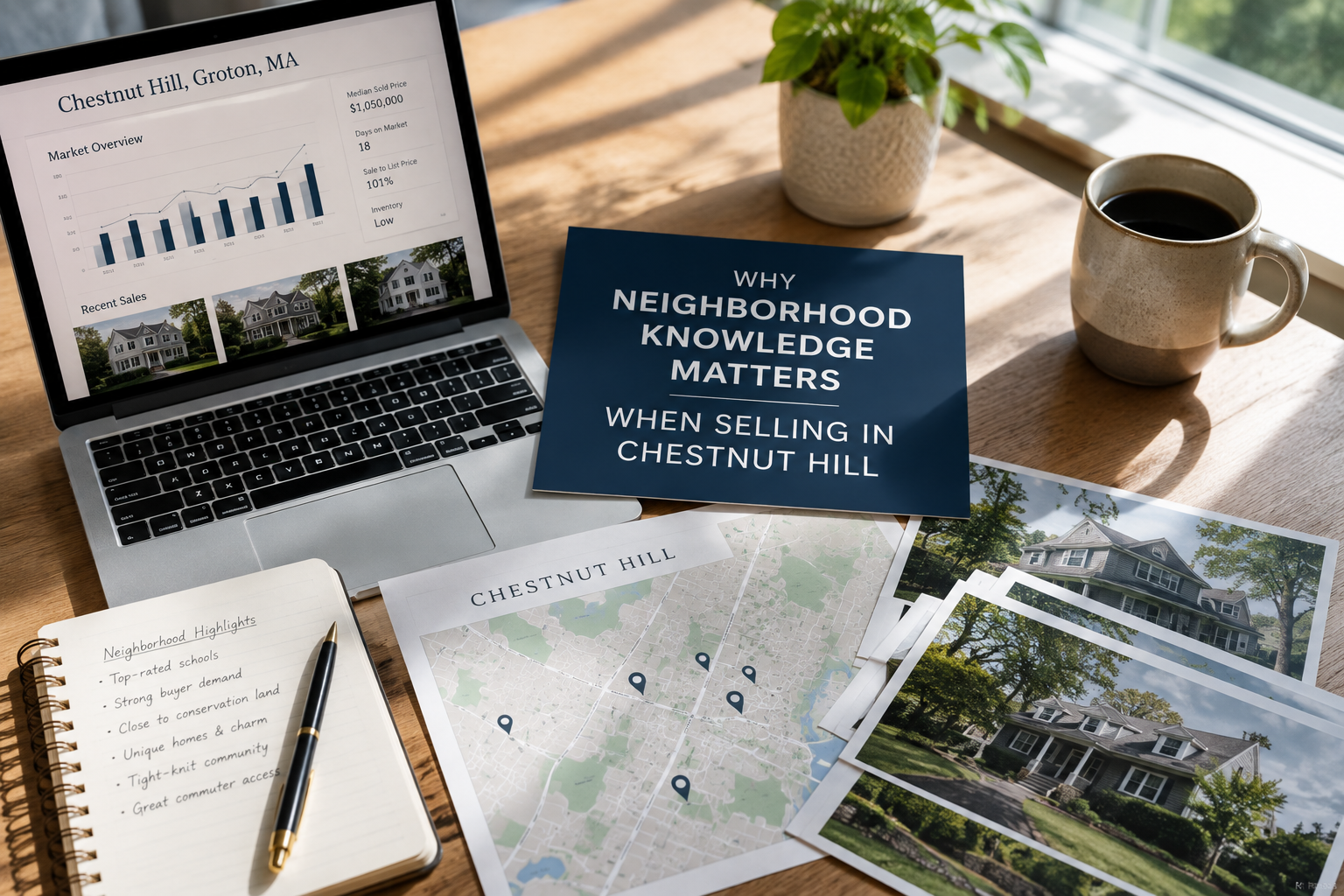
The Groton, MA real estate market is moving. Homes sold for a median price of $1,019,950 in June 2026, with properties spending an average of 46 days on the market compared to 52 days last year. Within the Chestnut Hill pocket specifically, the Middlesex County median price has climbed to $1,330,000, reflecting a 7.0% increase since last year.
But here is what those broad numbers do not tell you: Chestnut Hill is not "average Groton." The neighborhood has its own micro-dynamics, its own buyer profile, and its own pricing sweet spots. If you are thinking about selling your Chestnut Hill home in 2026, the agent you choose needs to understand those differences at a granular level. With 28 years in real estate and over 550 closed transactions across Acton, Groton, Westford, Chelmsford, and surrounding communities, we have learned firsthand that successful selling starts with knowing the market at the neighborhood level, not the zip code level.
How Chestnut Hill's Character Shapes Buyer Expectations
You already know what makes your neighborhood special. But can you articulate it in a way that resonates with today's buyers? That is the job of neighborhood knowledge, and it starts with understanding what draws people here in the first place.
Chestnut Hill sits within the Groton, defined by winding, mature residential streets that feel worlds away from the gridded subdivisions closer to Route 2. The canopy of decades-old oaks and maples along Chestnut Street, the long driveways, the homes set well back from the road: these are not just aesthetic details. They represent a lifestyle that a specific type of buyer actively seeks.
Groton has a higher proportion of four and five-plus bedroom homes than 98% of communities in America. The neighborhood features predominantly single detached homes with spacious three and four-bedroom layouts. Quiet streets contribute to a calm living atmosphere with limited noise and congestion. Your neighbors are largely tech professionals, engineers, and scientists. In fact, Groton has more residents working in computers and math than 95% of places in the United States, many commuting to the Route 2 and Route 128 tech corridors.
What does this mean for your sale? It means your buyer is likely well-educated, detail-oriented, and comparing your home to others in a very specific price band. If your listing description reads like a generic template, you have already lost their attention.
Why Broad Groton Statistics Can Mislead Chestnut Hill Sellers
Here is where sellers get into trouble. You look up the average home value in Groton, MA, which sits at $798,975 (up 1.5% over the past year), and you think you have a pricing baseline. But the reality is far more nuanced.
Groton home values range from $76,770 to $2,950,000. That is an enormous spread. Homes were listed to buy for a median price of $930K in June 2026 at $342 per square foot, but Chestnut Hill properties can command very different prices depending on lot size, condition, updates, and precise location within the neighborhood. Two homes with nearly identical square footage might generate completely different levels of buyer interest based on factors only a neighborhood-level expert would recognize.
We see this play out regularly. A seller whose home backs up to the Surrenden Farm Conservation Area has a different value proposition than one on a busier section of the neighborhood. The proximity to Groton Town Forest trails, the walking distance to Baddacook Pond, whether your lot catches afternoon light: these details matter to buyers, and they should matter in your pricing strategy.
Real estate appreciation rates in Groton have averaged 6.35% annually over the last ten years. But that average can mask significant variation between neighborhoods. When we prepare a pricing strategy for a Chestnut Hill listing, we look beyond broad Acton and Groton statistics and pay close attention to what is happening within this specific neighborhood.
What Chestnut Hill Buyers Are Actually Looking For
So who is buying in your neighborhood right now? Understanding this is not optional; it is essential to positioning your home correctly.
Buyers drawn to Chestnut Hill consistently value the combination of space, privacy, and convenience. They want mature landscaping, larger properties, and a true residential feel while remaining close to everything Acton and Groton have to offer. That balance is Chestnut Hill's signature.
Schools Drive Decisions
The Groton-Dunstable Regional School District is a major draw. Florence Roche Elementary School holds a GreatSchools rating of 8 out of 10. Groton-Dunstable Regional High School also rates 8 out of 10, with competitive AP course offerings and strong athletics. Lawrence Academy, a respected private prep school right on Main Street, adds another layer of academic appeal.
If your listing does not emphasize this school access clearly and specifically, you are leaving buyer motivation on the table.
Commute Convenience Seals the Deal
Your Chestnut Hill home puts buyers roughly 15 to 20 minutes from the Route 2 corridor tech cluster in Acton and Concord, and approximately 35 to 45 minutes from the Route 128 tech belt via Route 2 East. That commute profile attracts a reliable buyer pool of professionals who want suburban space without sacrificing career access.
Lifestyle Amenities Close to Home
Buyers want to know about Gibbet Hill Grill on Lowell Road, the farm-to-table destination with sweeping hilltop views. They want to hear about the Groton Inn on Main Street, the trails through Groton Town Forest, and the swimming at Baddacook Pond. An agent who can paint this picture with specifics, not generalities, gives your listing an emotional edge that generic marketing simply cannot match.
How Neighborhood Knowledge Directly Affects Your Sale Price
With 200 five-star reviews from past clients and recognition as a Top 4% Coldwell Banker agent worldwide, we have seen the financial impact of neighborhood expertise play out across hundreds of transactions. The difference between a well-positioned Chestnut Hill listing and a poorly positioned one is not abstract; it translates directly into dollars and days on market.
Property condition, lot size, updates, location within the neighborhood, and overall presentation all play important roles in how buyers perceive value. A kitchen renovation that makes perfect sense for a higher-priced property elsewhere in Groton might not deliver the same return in your specific price band within Chestnut Hill. Conversely, strategic landscaping investments that highlight Chestnut Hill's signature mature lot character can make a meaningful difference in first impressions.
One of our past clients described the experience this way: "Leah and Tricia talked with us and provided their experience and guidance when we had questions. Their Seller Roadmap was very helpful in keeping us on task and on track." That roadmap is built on neighborhood-level intelligence, not cookie-cutter advice.
Strategic Preparation for Selling in Chestnut Hill
You would not use a statewide weather forecast to decide what to wear tomorrow morning. So why would you use town-wide averages to price and market your Chestnut Hill home?
Strategic preparation means understanding the micro-market before you list. It means knowing which updates will resonate with the specific buyer pool drawn to this neighborhood. It means staging your home to emphasize the features that Chestnut Hill buyers value most: the views from the back deck, the flow between indoor and outdoor living spaces, the sense of privacy that comes from generous lot setbacks.
Another past client shared their perspective: "They are an outstanding team with invaluable knowledge and professional experience at every step of the process, from marketing to closing. They addressed our questions and concerns with patience, clear facts, thoughtful analysis, and a range of options to choose from."
That level of specificity, that range of options, comes from knowing a neighborhood well enough to tailor every decision to its unique dynamics.

Frequently Asked Questions About Selling in Chestnut Hill
Why can't I just use Groton-wide data to price my Chestnut Hill home?
Groton home values range from $76,770 to $2,950,000, which makes town-wide averages misleading for any single neighborhood. Chestnut Hill has its own buyer profile, pricing patterns, and value drivers. Using broad data risks overpricing or underpricing your home, either of which costs you money and time on the market.
What makes Chestnut Hill different from other Groton neighborhoods?
Chestnut Hill is defined by its mature landscaping, larger properties, winding residential streets, and a true sense of established neighborhood character. The homes are predominantly spacious single-family detached properties with three and four-bedroom layouts, attracting tech professionals and families who value both privacy and convenience.
How do schools affect my Chestnut Hill home's value?
The Groton-Dunstable Regional School District is a significant draw. Florence Roche Elementary rates 8 out of 10, and Groton-Dunstable Regional High School also rates 8 out of 10. Proximity to Lawrence Academy adds further appeal. Buyers relocating for schools will pay a premium for confirmed access to these programs.
What kind of buyers are looking in Chestnut Hill right now?
Groton has more residents working in computers and math than 95% of places in the US. The typical Chestnut Hill buyer is a tech professional or engineer commuting to the Route 2 or Route 128 corridors, seeking space, privacy, mature trees, and quality schools for their family.
How long are homes taking to sell in Groton in 2026?
Groton homes are selling after an average of 46 days on the market, compared to 52 days last year. Chestnut Hill homes that are priced accurately and presented well based on neighborhood-specific knowledge tend to perform at or better than this average.
Should I renovate before selling my Chestnut Hill home?
Not every renovation pays for itself, and the answer depends on your specific price point and buyer expectations within Chestnut Hill. Neighborhood knowledge helps determine which updates deliver the strongest return and which ones you can skip.
How much have Groton home values appreciated recently?
Real estate appreciation rates in Groton have averaged 6.35% annually over the last ten years. The Chestnut Hill, Middlesex County median price has reached $1,330,000 with a 7.0% increase since last year, reflecting strong demand for this type of established neighborhood.
What local amenities should I highlight when selling in Chestnut Hill?
Emphasize proximity to Groton Town Forest, Surrenden Farm Conservation Area, and Baddacook Pond for outdoor recreation. Gibbet Hill Grill and the Groton Inn are lifestyle draws that resonate with buyers seeking village-character living. The Route 2 commute corridor is also a major selling point.
Is 2026 a good year to sell my Chestnut Hill home?
Groton home values are up 1.5% over the past year, and the broader Middlesex County pocket shows even stronger growth at 7.0%. Combined with faster selling times (46 days vs. 52 last year), market conditions in 2026 favor well-prepared Chestnut Hill sellers.
How do I find an agent who truly knows Chestnut Hill?
Look for agents with deep transaction history in the Acton, Groton, and Westford area, not just a general license to sell. With over 550 closed transactions and 28 years of experience specifically in these communities, we bring the kind of neighborhood-level insight that generic market coverage simply cannot replicate.
The Bottom Line on Selling in Chestnut Hill
Your Chestnut Hill home is not a data point on a spreadsheet. It is a property with specific advantages tied to its lot, its location within the neighborhood, its proximity to trails and conservation land, and its appeal to a well-defined buyer pool. Selling it well requires an agent who understands those advantages and knows how to position them in today's market.
Whether you are a longtime homeowner weighing the right time to sell or simply exploring your options, we would love to help you think through your next move. Reach out to us, Tricia Eggert and Leah Paglia with the Reliable Results Team, at 978-496-8695. Chestnut Hill is a community we are proud to know and serve, and we bring 28 years of experience plus over 550 transactions to every conversation.